

Tech Startup Founder at a glance
- To start
- Nothing. A seed round follows your first choices
- The choices
- 10 products · 6 pricing models · 7 channels · 5 ways of working
- Bankruptcy
- Your second year in the red
- The exits
- Buyout from $250k revenue · IPO from $100M
In US dollars. The game shows the same amounts in the money of whichever country you live in.
The four choices
The product can be an operating system, an ERP system or a computer in any era. Databases, frameworks, SaaS and cloud become available in 1991, and big data, data labelling and AI in 2017. Which ones you can pick depends on when your character was born.
To charge for it, you pick one of six models: ads, freemium, open source with paid support, a marketplace cut, a paid product or an enterprise licence. To find customers, you pick from word of mouth, a sales team, trade shows, print and billboards, search ads, social media and influencers, or television. Each channel needs a certain amount of charisma from you. Your team can work waterfall, design-led, data-driven, agile or lean, and each of those needs some management skill.
The product and the pricing are locked once you choose them. The channel and the way of working can be changed later. Behind all of it is a table of 76 pairings that decides what goes with what. The game never shows it to you.
Building and running the company
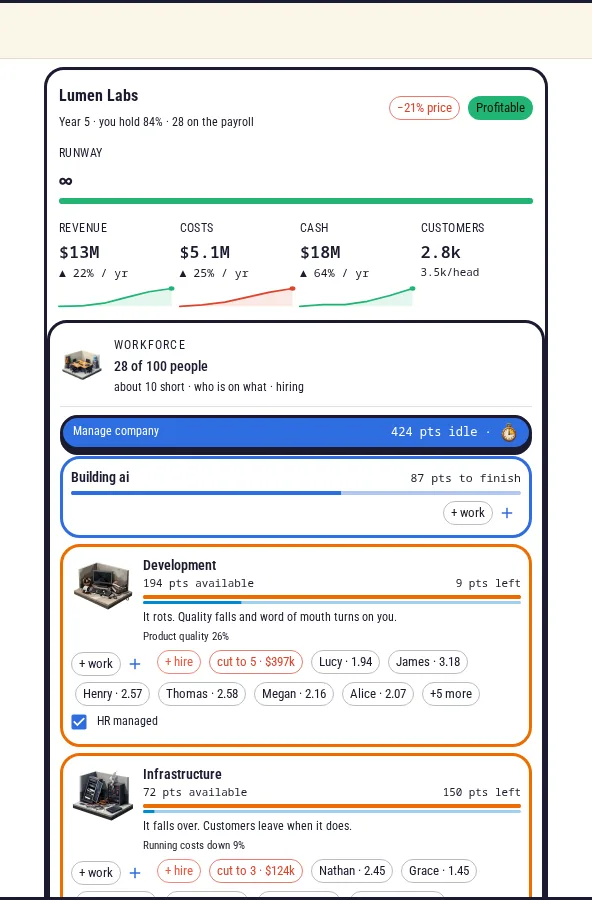
Nothing sells until the product ships. You can ship a bare minimum or keep rebuilding until it's right, and the most polished version takes twenty times the work of the first. Each new product costs twice as much as the one before, and after a few years customers start drifting away from the old ones.
Each year you can put up to 16 of your own time points into building or into a department. Staff come in four grades, from interns to the best people available, across six departments. HR only shows up once the office holds 100 people. The first ten desks are free, and the bigger offices cost $1M, $25M and $500M. Your own living costs are paid by the company.
How it goes wrong
You're allowed one year in the red. The second one is bankruptcy. If you own less than half the company and it's losing money, the board can push you out. Growing by more than 10% a year attracts competitors, who can force your price down by as much as 60%. Other companies poach your staff, people ask for raises, and your investors (some want growth, others want returns) get moody.
Selling or going public
Once revenue reaches $250,000, buyers start making offers, and you get your share of the price. To go public you need $100M in revenue, a profit and three years of accounts. A listed company stays in your portfolio and pays you part of its earnings every year, whatever you do with the rest of your life.
Questions
Do I need money to start a company?
No. There's no entry requirement. Once you've chosen what to build and how to charge for it, investors put in a seed round in exchange for part of the company.
Can I lose my own startup?
Yes. A second year in the red means bankruptcy, and if you own less than half of a company that's losing money, the board can push you out.
Is running the startup all I do in that life?
No. It's one career inside a life simulator. You still have a family, a home and a body that gets older, and a company that goes public keeps paying you after you move on.
The other special careers
Each one has its own screen and its own money, and you can try more than one in a single life.







Start a life
It's free and it runs in your browser. You'll be born, grow up, and find out whether this life ever gets the chance.