
Musician at a glance
- To start
- Music skill 15 and a piano or a microphone
- The rooms
- Bars 120 · clubs 400 · theatres 3,000 · arenas 20,000
- A year with no record
- Costs you 5% of your fans
- Label deals
- 1, 3 or 5 records, due at the end of the year
Writing records
A record costs inspiration and two time points, and there are three ways to write one. Everything you have costs 4 inspiration and has no ceiling. A working record costs 2 and goes silver at best. Something to ship costs 1 and never gets certified. You can put out three records of your own a year, and if your mood drops below 30 you can't write at all.
Most records grow your fanbase by about a tenth. Around one in thirty of your best records goes silver or better, about one in a hundred goes gold, and about one in a thousand goes platinum. When one does, the game stops to show you the disc.
Inspiration
Inspiration works like a savings account. It earns 12% of itself every year. You can top it up by getting out and living a little, up to 6 a year, and walks and books in your free time count too. Sleeping short halves what living a little gives you.
Touring
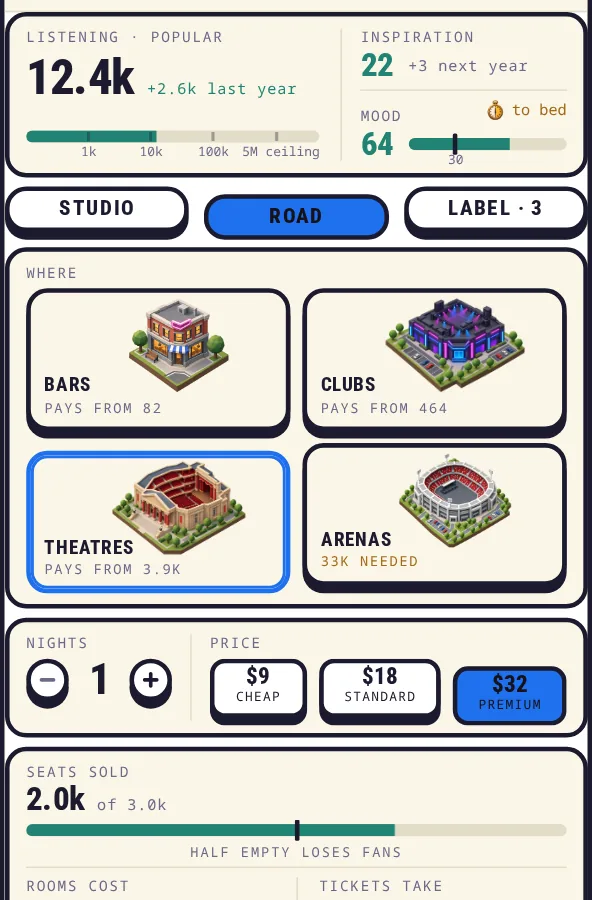
There are four kinds of venue. You can book up to 8 nights in bars, 15 in clubs, 25 in theatres and 50 in arenas, and every four nights take one time point. There are five ticket prices, and the dearer ones unlock at 500, 5,000, 50,000 and 500,000 fans. Before you book, each venue shows how many fans it takes to break even, and the screen shows how many seats you'd sell and what the rooms and the tickets come to.
A room less than half full loses you fans, and the emptier it is, the more you lose. A room more than 90% full gains you some. Once you've booked, the tour plays out on a gig poster one night at a time while the seats fill and the takings add up. The real turnout can come in a little above or below the estimate.
Record labels
After two years in the career, labels start making offers. Each one is priced against the best tour you could book in a year. A chill deal pays about that much, a quarter of it when you sign, for one record and 10 time points. A normal deal pays about 1.8 times as much, 40% up front, for three records and 14 time points. A hard deal pays about 3.5 times as much, 60% up front, for five records and 17 time points, which only fits if you sleep less.
The label quotes how much inspiration it needs to get started, but the real amount can come in up to 40% higher. If you're short, the rest comes out of your mood, as long as that doesn't take you below 30.
Delivering, or walking away
The records are due at the end of the year. If your mood is below 30 by then, you can't write them and the contract breaks: you pay back what you got when you signed, plus a fine. You can also walk away before then for the same price and get the time back. While you owe a label records, you can't leave the career.
What you keep
Your records stay in your catalogue, along with any gold or platinum. Royalties are small, and they stop when you leave the career. The money you keep is what you made while you were filling rooms.
Questions
How do I become a musician in OpenLifeSim?
Get your music skill to 15 (school, lessons and practice all count) and take the career. You'll need a piano or a microphone before you can write or tour.
Do tours make money?
Not always. The screen shows what each room needs to break even and how many seats you'd sell before you book. Fill a room at least halfway, or the tour loses you money and fans.
Can I get out of a record deal?
Yes. You can walk away before the end of the year by paying back what you got when you signed, plus a fine, and you get the year's time back. If your mood is below 30 when the year ends, the deal breaks by itself for the same price.
The other special careers
Each one has its own screen and its own money, and you can try more than one in a single life.







Start a life
It's free and it runs in your browser. You'll be born, grow up, and find out whether this life ever gets the chance.